







Where UK House Prices Are Heading by 2030
The United Kingdom residential market stands at a critical juncture in late 2026. With average house prices at £273,000 in August 2026 according to the ONS and annual growth of just 0.9% over the preceding 12 months, the market has moved past the sharp corrections of previous years but lacks strong momentum. Investors must now assess which long-term forces will shape returns between 2026 and 2030.
Current Market Fundamentals in 2026
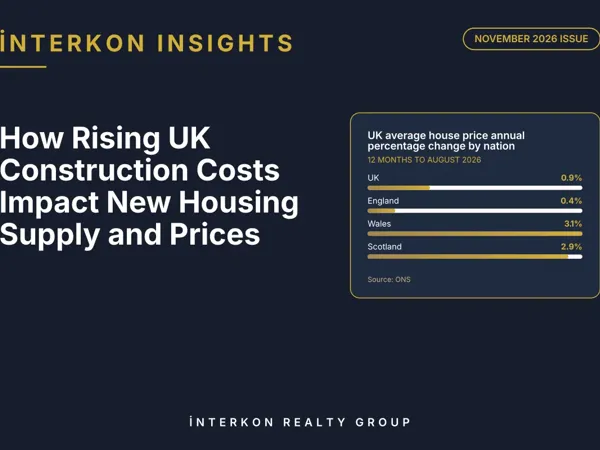
Official data reveals a stabilising but regionally divergent picture. Average house prices reached £294,000 in England and £216,000 in Wales in August 2026, with Wales recording stronger annual growth of 3.1% compared with England’s modest 0.4%. Private rents continue to rise faster than prices, increasing 3.8% year-on-year to an average of £1,406 per month in September 2026.
Construction output prices rose 3.2% in the 12 months to September 2026, signalling persistent cost pressures on new supply. Against this backdrop, the UK currently offers a gross rental yield of 6.18% and an average amortisation period of 16.2 years according to Interkon Insights calculations.
| Region | % |
|---|---|
| UK | 0.9% |
| England | 0.4% |
| Wales | 3.1% |
| Scotland | 2.9% |
Source: ONS
Why Rental Yields Matter More Than Price Growth in 2026
In an environment of subdued capital appreciation, income return has become the dominant driver of total return. The 6.18% gross yield provides a respectable income buffer, particularly when compared with many European markets. However, investors should note that net yields after maintenance, voids and management costs will be materially lower.
Those considering diversification away from high-inflation environments should weigh the UK’s current stability against other opportunities. For instance, Turkey’s housing price index rose 22.34% in the 12 months to September 2026 according to TCMB data. While this delivers significantly higher nominal growth, it comes with considerably higher currency and inflation risk, making the UK a more predictable income-focused alternative for many international portfolios.

Long-Term Drivers Shaping 2026-2030
Structural undersupply, evolving immigration policy, interest rate trajectory and regional economic divergence will determine outcomes. Planning reform progress, labour availability in construction, and the pace of real wage growth are equally critical variables. The interaction of these forces creates a wide range of plausible paths for the next five years.
UK Housing Scenarios 2026-2030
Three distinct scenarios emerge for the period ahead. Each assumes different combinations of interest rates, inflation, housing supply delivery and domestic and international demand.
| Scenario | House Price Growth (Annual) | Rental Growth (Annual) | Amortisation Period Trend | Construction Cost Growth (Annual) |
|---|---|---|---|---|
| Optimistic | 3.5%-5.0% | 4.0%-5.5% | Gradual compression to 14-15 years | 2.0%-3.0% |
| Base Case | 1.8%-3.0% | 2.5%-3.8% | Stable between 16-17.5 years | 2.5%-3.5% |
| Pessimistic | 0.0%-1.5% | 1.0%-2.5% | Extension toward 19-21 years | 3.5%-4.5% |
These ranges represent compounded annual rates and are not forecasts but plausible corridors based on differing macroeconomic and policy assumptions. Actual outcomes will depend on how these variables interact. No scenario guarantees returns.

Investment Implications for International Buyers
The UK market in 2026 rewards patience and selectivity rather than aggressive capital growth expectations. Regions with strong rental demand, constrained supply and favourable demographics are likely to outperform in the base and optimistic scenarios. Conversely, areas heavily exposed to public sector employment or facing significant new supply risk warrant caution under the pessimistic case.
Foreign investors comparing the UK with Turkey should consider the trade-off between high nominal growth in Turkish cities and the greater transparency, political stability and rule of law offered by the British market. Currency hedging costs and liquidity differences must also be modelled carefully before committing capital.

Frequently Asked Questions
Is the UK still a viable market for capital growth in 2026?
Capital growth is expected to remain modest in the base case. However, selected regional markets with strong fundamentals may still deliver attractive total returns when rental income is included. Investors seeking high single-digit annual price appreciation are likely to be disappointed in most plausible scenarios.
How does the current UK gross yield compare internationally?
At 6.18% in August 2026, the UK offers one of the more attractive gross yields among developed Northern European markets. This yield level provides a meaningful income component that can support total returns even when house price growth remains subdued.
Which scenario should foreign investors prepare for?
Prudent investors should stress-test portfolios against the pessimistic case while positioning for the base case. Maintaining flexibility, focusing on locations with robust rental demand and avoiding excessive leverage remain sound principles across all three scenarios through 2030.
This content has been prepared by İNTERKON REALTY GROUP and İNTERKON INSIGHTS for informational purposes only. Data is compiled from publicly available official sources (ONS, HM Land Registry). Amortization periods are calculated on a gross yield basis. This article does not constitute investment advice. Professional advice should be sought before making any investment decision. İNTERKON REALTY GROUP and İNTERKON INSIGHTS cannot be held liable for any damages arising from the use of this information.